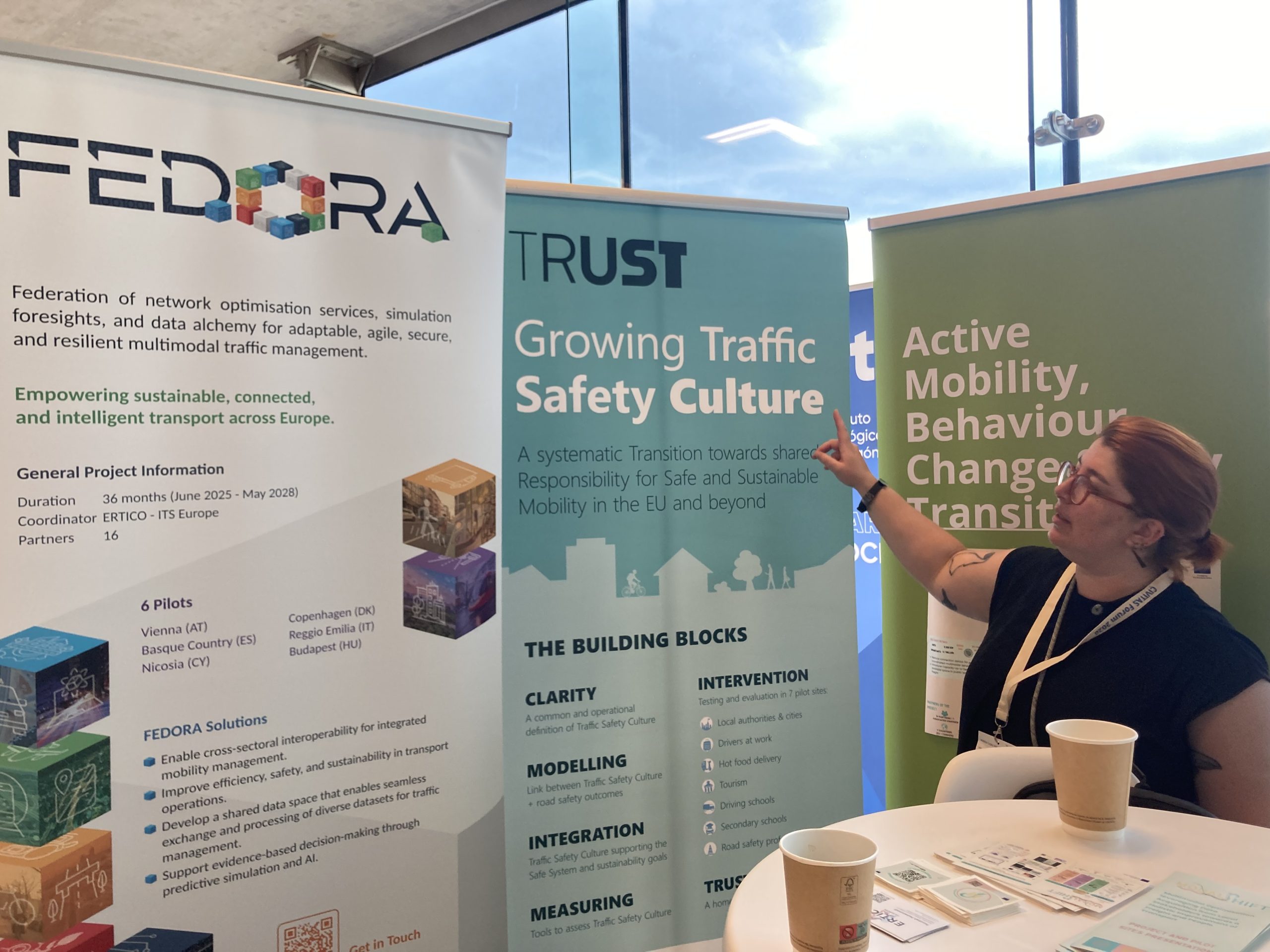
TRUST partners continue to disseminate the work they are doing within the TRUST project at conferences, external events and in publications. TRUST at the Civitas forum with TRUST Pilot 1 – Municipalities and regional authoritiesTRUST was at the Civitas Forum held in Thessaloniki in September. It was a great opportunity not only to present our project in general, but also to disseminate details of the training course developed and run under our Pilot 1. This training course is for municipalities and regional authorities wanting to strengthen the traffic safety culture of their organisation. The TRUST training course will be held online and starts on 11 November (EN version). To register and find more check out our website here: https://lnkd.in/e6TVAEAG Publications using TRUST results that have been published or are awaiting publication: Partner/Lead Author Title Journal/conference Date Nævestad, T.-O., Meesmann, U., Wallén Warner, H., Kaiser, S., Milch, V., De Roeck, M., Schachner, M., Nikolaou,D., Björklund, G., Laiou, A., Storesund Hesjevoll, I., Forward, S., Wennberg, H., Aigner-Breuss, E., & Eichhorn, A. Traffic safety culture within the Safe System: Developing a common definition of traffic safety culture. Frontiers in Sustainable Cities. 15 July 2026 Nikolaou D., Laiou A., Sekadakis M., Kyprouli D., Yannis G. A Systematic Review of Traffic Safety Culture in Relation to New Mobility Modes, Technology and Policy Developments Safety 16 October 2026 Uta Meesmann, Dimitrios Nikolaou, Carlos Pires, Tor-Olav Nævestad, Alena Katharina Høye, Susanne Kaiser, George Yannis Link between traffic safety culture and road safety performance across 22 European countries IATSS Research Under review
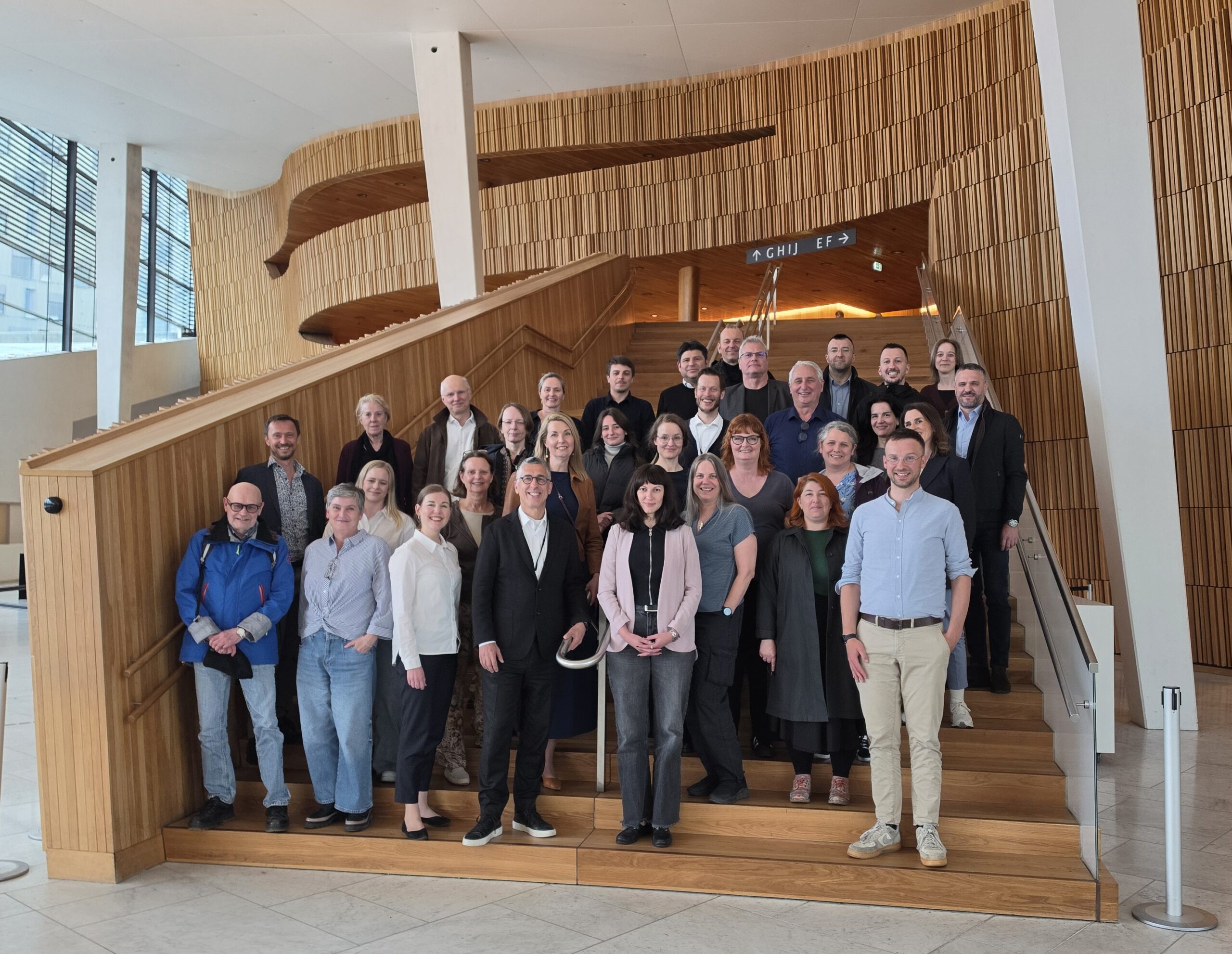
TRUST | An abstract idea becomes tangible: a message from the project coordinators
Across Europe, road safety experts increasingly agree on one fundamental point: lasting reductions in road deaths and serious injuries require enriching our proven traditional road safety effort by understanding how road users and institutions think and decide, i.e. their traffic safety culture. We all have an intuitive perception that road users are influenced by their culture. Personal experiences of driving in another country come to mind – or how foreign road users act on our familiar routes. In fact, we are all subject to multiple cultures. And while a country’s culture explains some of its behaviour – due to shared jurisdictions, history and experience – the decisions of road users may equally be shaped by additional cultural layers, such as shared beliefs within a family or among friends about how we are supposed to act. To change road users’ culture requires a shared definition of what Traffic Safety Culture is and a common understanding among road safety researchers and professionals. Once there is consensus, we are one step closer to measuring and growing Traffic Safety Culture effectively. The Safe System approach emphasises the principle of shared responsibility and the crucial role of organisations for safe mobility. Yet, institutional silos persist and one-off safety interventions are widespread. Where safety culture is weak, safety measures may be perceived as additional burden – costly and restrictive. Where culture is strong, safety becomes a core organisational value, influencing design standards, enforcement practices, training, and daily operational choices amongst other things. A strong Traffic Safety Culture provides a common purpose, enabling alignment of priorities and making collective decisions focused on reducing harm. Systems thinking also means thinking outside the (safety) box, so, for instance, environmental sustainability become a road safety ally. Strengthening culture does not have to be an abstract ambition. The TRUST project has taken on the challenge and is working towards establishing a common language and definition, measurement tools and interventions by 2028. By Susanne Kaiser and Klaus Machata

From evidence to consensus: a common definition of traffic safety culture for research and policy
Every year, around 20,000 people lose their lives on roads in the European Union, and at least 100,000 are seriously injured. To continue improving road safety, we need to look beyond technology and focus on the shared beliefs, values, norms, and behaviours that shape the transport system. This is often referred to as Traffic Safety Culture (TSC). Despite increasing attention in research and policy, no commonly accepted definition of TSC currently exists. Different studies and organisations have conceptualised TSC in different ways, making it difficult to compare findings, measure progress, and apply the concept consistently in practice. One of the first actions of the TRUST project was to address this gap by developing a shared definition that can support both research and policymaking. To achieve this, we combined several complementary approaches. Firstly, we reviewed the scientific literature to see how TSC has been defined and studied so far. Secondly, we engaged international experts in a structured consensus-building process (Delphi study) to identify TSC’s key components. Finally, we used group discussions to refine and test these ideas in practical, real-world contexts. Across all stages of the research, strong agreement emerged, resulting in the following definition: “Traffic Safety Culture encompasses shared values, beliefs, attitudes, norms, and patterns of behaviour that shape how traffic safety is understood and enacted within a meaningfully defined group of actors in the transport system. These groups can include road users, organisations, authorities, or other actors within the transport system.” This definition provides a clear and consistent foundation for future research and policy development. TSC still varies according to societal and organisational contexts. Workplace driving, everyday road use, and public sector responsibilities may each involve distinct norms, expectations and safety challenges, even when they share common underlying cultural elements. But, by moving from fragmented interpretations to a shared understanding, this common definition supports a more coordinated approach to improving road safety across Europe. A copy of TRUST deliverable 2.1 in which the TSC definition is described in more detail will be available on our website soon. By Uta Meesmann and Mathias De Roeck

Studying the link between traffic safety culture and road safety outcomes
Better roads, safer vehicles, traffic laws and enforcement all matter. But they are not enough on their own. To make roads safer, we also need to understand the everyday beliefs, habits and expectations that shape how people behave in traffic. This is what we mean by traffic safety culture. It concerns what people in a group see as normal and acceptable: Is it normal to speed? Is it acceptable to drive after drinking? Do friends encourage risky driving, or do they speak up? Do parents model safe driving for young people? Such shared expectations may influence how people behave on the road. In our study, we reviewed a large body of international research on the relationship between traffic safety culture and road safety among private road users, including drivers, cyclists, motorcyclists and pedestrians. The studies examine traffic safety culture at different levels and in different types of formal and informal social groups. The review indicates that traffic safety culture may be relevant for road safety, particularly through its relationship with behaviour. A recurring theme in the literature is the role of shared norms. People may be influenced by what they believe others usually do, and by what they think others accept. These expectations can support both safe and risky behaviour. The reviewed research also points to the importance of close social relationships. Young drivers, for example, may be influenced by parents’ driving habits, family rules and peer expectations. Local social norms around alcohol use may also be relevant for understanding drink-driving. At a broader level, social values and shared expectations may contribute to understanding why road safety outcomes differ between places. At the same time, the relationship between traffic safety culture, behaviour and crashes is complex. Not all studies find the same patterns, and the field still faces important methodological challenges. More research is needed to better understand how traffic safety culture can be measured, how it relates to behaviour and safety outcomes, and how it can be influenced in practice. This work is important because road deaths and injuries affect everyone: families, local communities, health services, employers and public authorities. Safer road cultures can help protect children, young people, older people, cyclists, pedestrians and drivers alike. The purpose of this review is to improve knowledge about which aspects of traffic safety culture appear most relevant for road safety. This can help identify what needs to change, and where road safety efforts should be targeted. In the TRUST project, we will also develop knowledge about how traffic safety culture can be influenced in practice. The long-term goal is to strengthen safer shared norms, attitudes and behaviours, and thereby contribute to reducing the number of people killed and injured on our roads. By Tor-Olav Nævestad
Testing TRUST interventions in secondary schools
The TRUST project will test and evaluate different interventions to improve Traffic Safety Culture (TSC) in different settings. These are called the TRUST pilots. One of the TRUST pilots will focus on secondary schools.
TRUST publications
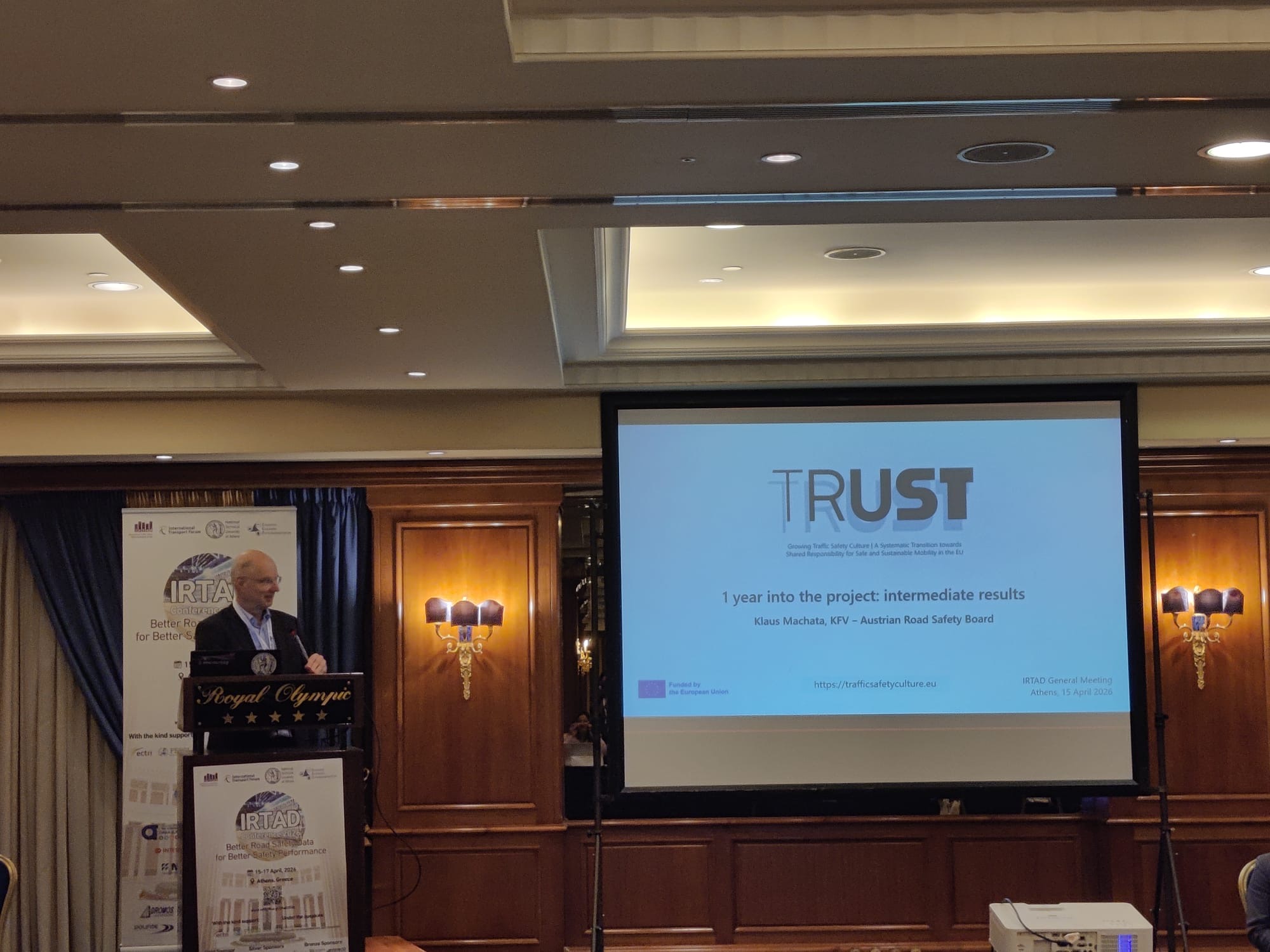
The first year of the TRUST project saw TRUST project partners present at two major road safety conferences and have one journal paper accepted for publication. Abstracts have also already been accepted for year two of the project. The TRUST project has also been presented at IRTAD and FERSI meetings and at a meeting with the Italian Minister of Transport. Here is a overview of TRUST publications: Partner/Lead Author Title Journal/conference Date Tor-Olav Naevestad, Hanna Wennberg, Susanne Kaiser, George Yannis, Alexandra Laiou, Dimitrios Nikolaou, Jenny Blom, Vibeke Milch, Ingeborg Hesjevoll, Wouter Van den Berghe, Uta Meesmann and Mathias De Roeck Towards a Traffic Sustainability Culture: Integrating Safety and Sustainability in Line with the Stockholm Declaration IRTAD 2026 (abstract and presentation) April 2026 Tor-Olav Naevestad, Susanne Kaiser, George Yannis, Alexandra Laiou, Dimitrios Nikolaou, Jenny Blom, Vibeke Milch, Ingeborg Hesjevoll, Hanna Wennberg, Gunilla Björklund, Henriette Wallen Warner, Uta Meesmann, Mathias De Roeck, and Wouter Van den Berghe Development of a conceptual model for Traffic Safety Culture IRTAD 2026 (abstract and presentation) April 2026 Susanne Kaiser, Graziella Jost, Klaus Machata, Wouter Van den Berghe, Uta Meesmann, Tor-Olav Nævestad, George Yannis, Dimitrios Nikolaou, Henriette Wallén Warner and Jenny Carson TRUST – Growing a Positive Traffic Safety Culture in the EU TRA 2026 (abstract and poster) May 2026 Tor-Olav Nævestad, Hanna Wennberg, Susanne Kaiser, George Yannis, Alexandra Laiou, Dimitrios Nicolaou, Jenny Blom, Vibeke Milch, Ingeborg Hesjevoll, Wouter Van den Berghe, Uta Meesmann and Mathias De Roeck Advancing Traffic Safety Culture: Developing a Conceptualisation of Cultural Maturity Among Traffic Safety Stakeholders TRA 2026 (abstract and poster) May 2026 D. Nikolaou, A. Laiou, S. Kaiser, A. Eichhorn, E. Aigner-Breuss, U. Meesmann, G. Yannis A systematic review of Traffic Safety Culture definitions RSS 2026 (journal article, poster and presentation) June 2026 Nævestad, T.-O., Meesmann, U., Wallén Warner, H., Kaiser, S., Milch, V., De Roeck, M., Schachner, M., Nikolaou,D., Björklund, G., Laiou, A.,Storesund Hesjevoll, I., Forward, S., Wennberg, H., Aigner-Breuss, E., & Eichhorn, A. Traffic safety culture within the Safe System:Developing a common definition of traffic safety culture. Frontiers in Sustainable Cities. (journal article) July 2025
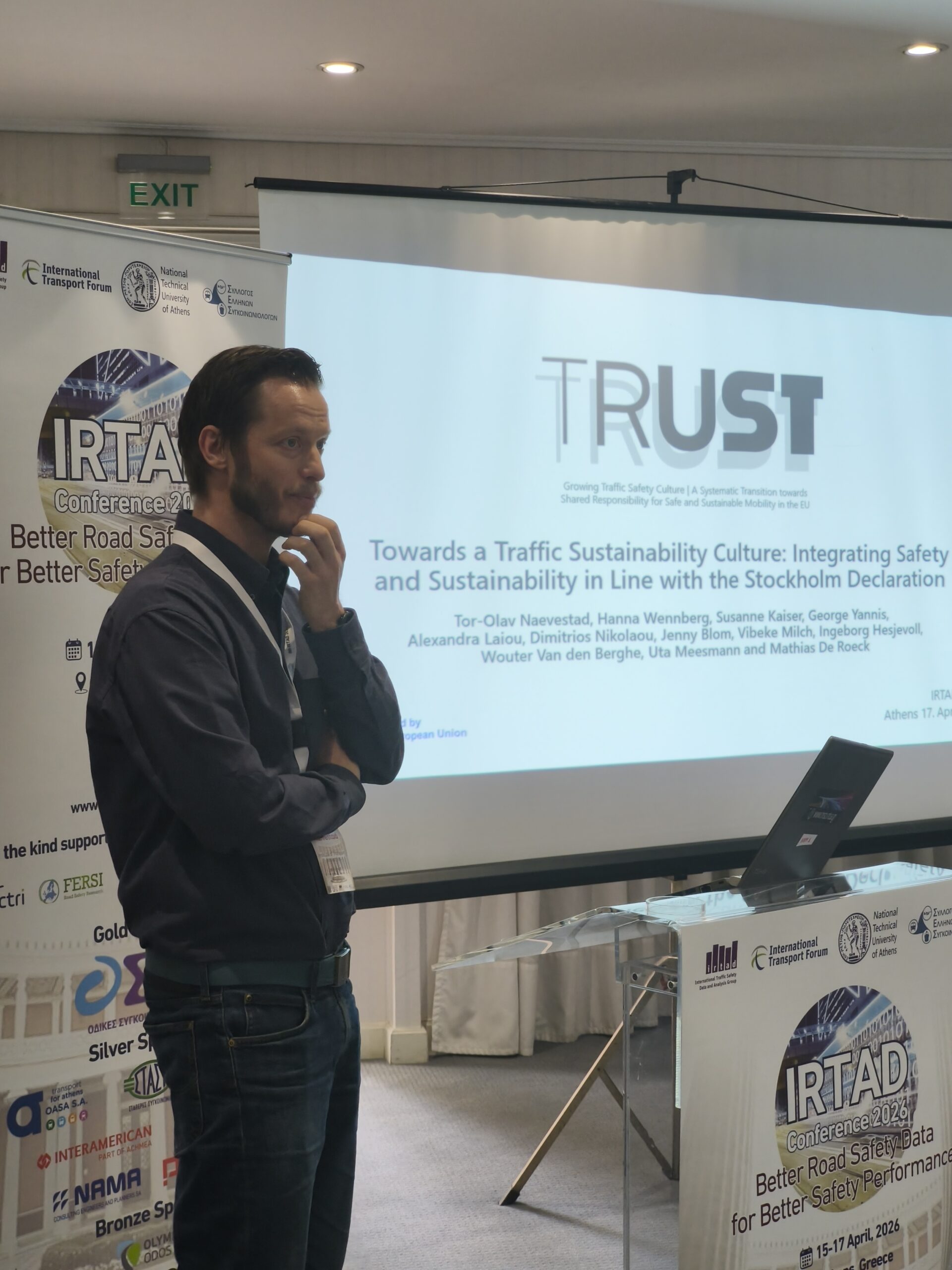
TRUST project partners at the IRTAD conference – April 2026
The IRTAD conference was held with great success in Athens in April 2026. TRUST partner TOI, represented by Tor-Olav Nævestad, presented the TRUST abstract – Development of a conceptual model for Traffic Safety Culture – which gave an overview of how the TRUST project has sought to better define and operationalise Traffic Safety Culture (TSC) by mapping previous research on traffic safety culture, and from there developing a conceptual model of traffic safety culture. A copy of the abstract given by Tor-Olav can be found on the TRUST website here. A copy of his presentation can be found here. A second TRUST abstract – Towards a Traffic Sustainability Culture: Integrating Safety and Sustainability in Line with the Stockholm Declaration – was also presented by Tor-Olav. A copy of this abstract can be found here. A copy of the presentation given by Tor-Olav can be found here.
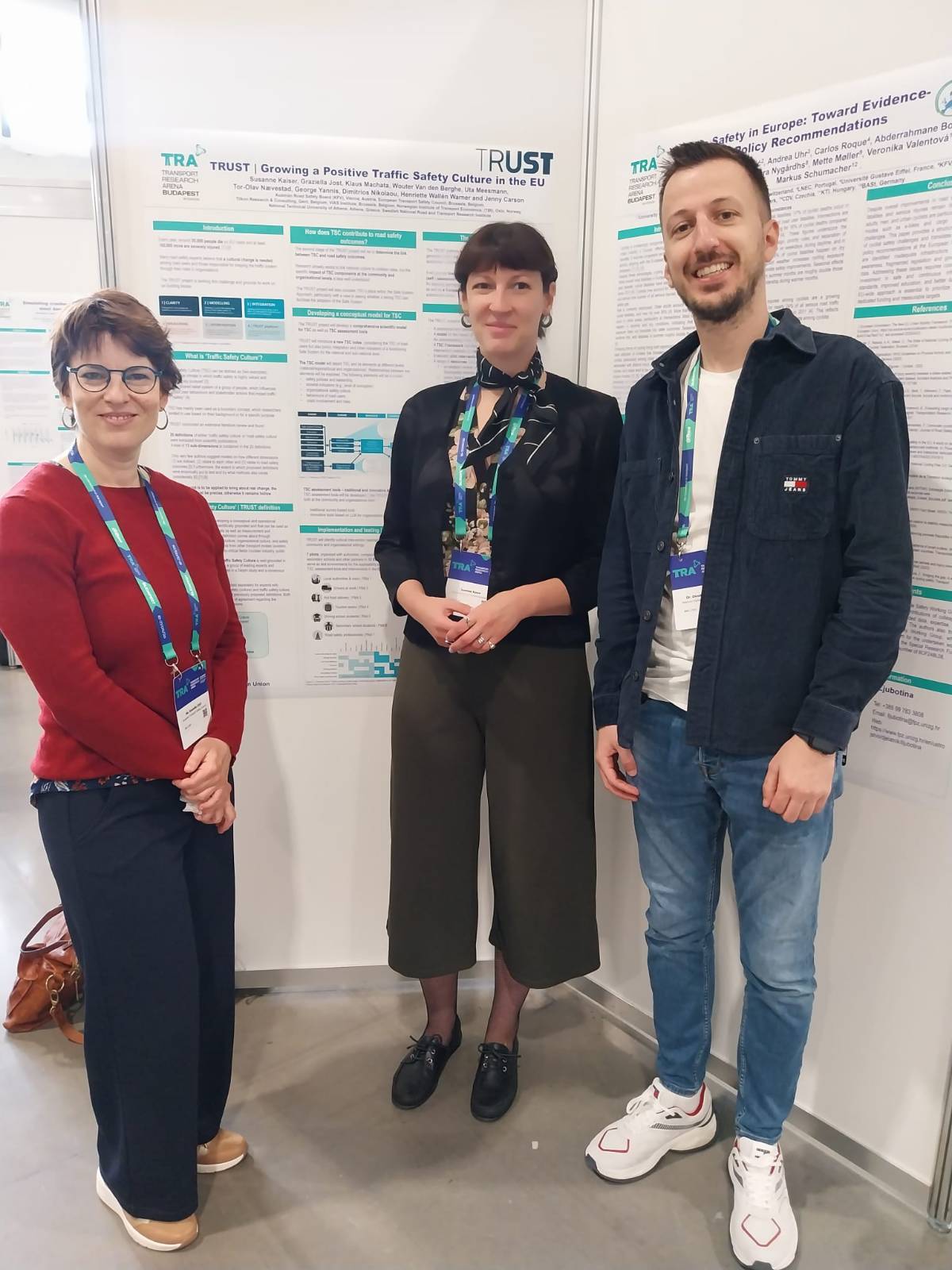
TRUST partners at the TRA conference – May 2026
The Transport Research Arena (TRA) conference organised by the European Commission is one of the most important EU transport research events. Only held every two years, TRUST was pleased to have 2 abstracts and 2 posters accepted by the event. The abstract: Advancing Traffic Safety Culture: Developing a Conceptualisation of Cultural Maturity Among Traffic Safety Stakeholders, describes how a study carried out within the TRUST project will develop a conceptualisation of Traffic Safety Culture among stakeholders involved in Safe System implementation, considering that Safe System implementation is often impeded by insufficient culture and low cultural maturity among stakeholders and that existing Traffic Safety Culture (TSC) research primarily focuses on road users at the community and organisational levels, with limited attention to stakeholders and their roles. A copy of the abstract can be found here. A copy of the poster presented on the abstract can be found here. The second abstract: TRUST – Growing a Positive Traffic Safety Culture in the EU, explains how and why the TRUST project will explore the options for improving Traffic Safety Culture (TSC) in Europe. It goes on to explain how the project will develop measures for improving TSC and how these measures will be evaluated in seven pilots, working with municipalities, businesses and schools. Tools, benchmarking facilities and guidance developed through the project will be accessible through the TRUST platform. A copy of the abstract can be found here. A copy of the poster can be found here.